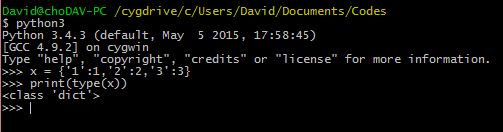
Here’s the working program.

Here’s the source code and my GitHub repository.


Here’s the working program. It’s really long because I gave the user options.

Here’s the image before and after


Here’s the source code and my GitHub repository.

Calculating value of e
e – Euler’s number
Here’s the working program

Here’s the source code and my GitHub repository.


Here’s the working program.

Here’s the source code and my GitHub repository.


Here’s the working program

Here’s the source code and my GitHub repository.


Here’s basically any WSQ we’ve done, in most of them user input is needed.
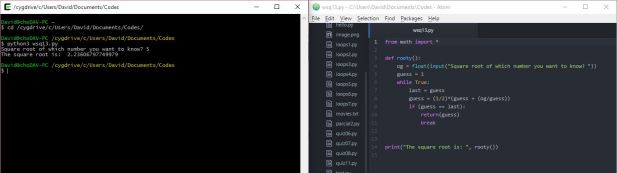
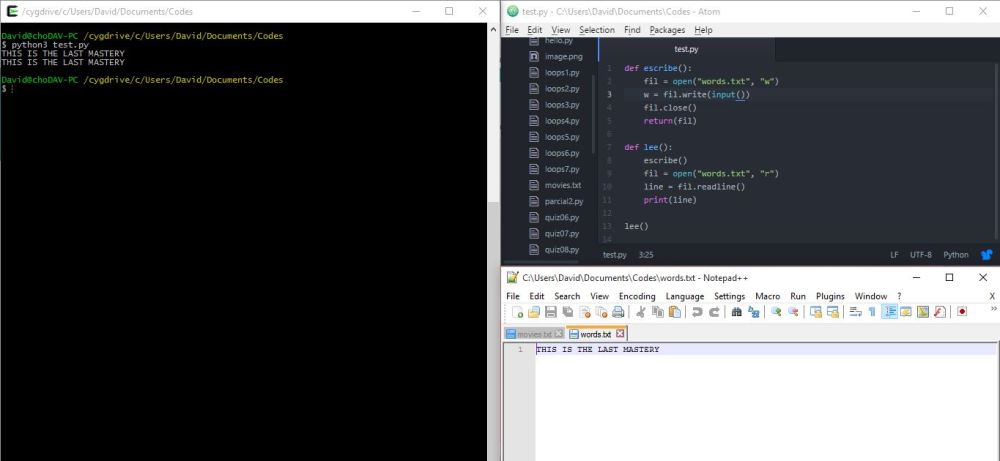
Mastery 30 – Reading and writing of files in Python
Here’s an example code I made to demonstrate I know how to write and read files in Python.


Here’s Quiz 11 in which I used lines of a document, of type string to check for the banana word.

Mastery 27 – Creation and use of dictionaries in Python
Here’s the progress I have from WSQ17 in which I create and use a dictionarie.


Here’s WSQ10 in which I created and used a list.

Mastery 25 – Creation and use of ranges in Python
Here’s WSQ 14 in which is created and used a range in a for loop. You can algo assign it to a variable and use it for other purposes.


Here’s WSQ 09, in which I use nesting of conditional statements.

Mastery 22 -When to use what type of repetitions on a program.
There are two types of loops in Python, while and for loops, when you want to make a repetition indefinite number of times to use a while, this will go until a condition is met. When you know the number of repetitions you need to make you use a for loops, which go the number of times you tell it to go.


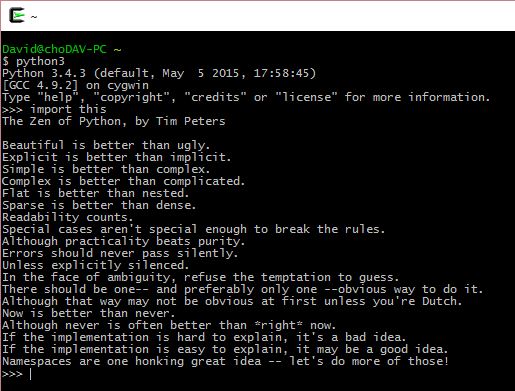
Here’s the Zen of Python running inside my shell.
Mastery 09 – Basic type and their use in Python
Python has 6 different basic types of data. They are:
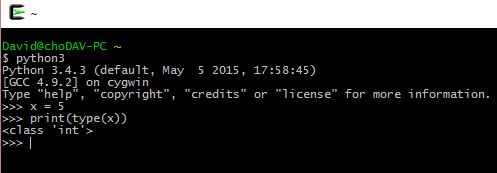
- Integers
These are numbers that belong to all the real numbers.
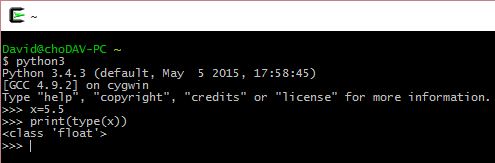
- Floating point numbers
These are all the real numbers that use decimals.
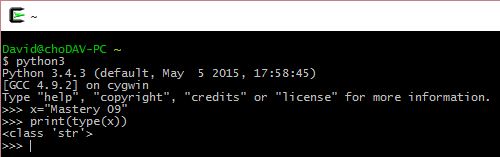
- Strings
These are a set of letters, numbers or any other character. They are inbetween quotation marks (“”).
- Tuples
This is an ordered set of values with fixed number of elements, goes inbetween parentheses. - Lists
This is an ordered set of values without fixed number of elements, goes inbetween brackets.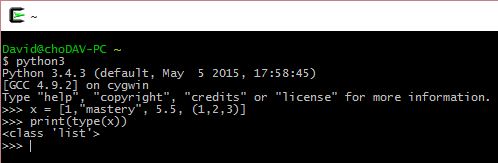
- Dictionaries
This is a type with different elements, used to map keys to their assigned values. They keys and values can be of any type.