
This was quite easy, the thing is that now we had time to look how to do the code and not the pressure of the examn on our backs. Here it goes:
Question 1

The exe:

Question 2 Code

Exe

Question 3 code

Exe

Question 4 code

Exe

Here are my codes.
LATER!


Fundamentals and Solutions. Together!

This was quite easy, the thing is that now we had time to look how to do the code and not the pressure of the examn on our backs. Here it goes:
Question 1
The exe:
Question 2 Code
Exe
Question 3 code
Exe
Question 4 code
Exe
Here are my codes.
LATER!
Well kind of late but here are my codes from the partial exam, I will leave links for my codes in Github, hopefully you’ll find useful.


Today I’m going to show you my second partial exam of my course. It was not a very hard exam and I’m proud of my work in it.
Lets start!
The exam said that we need to write four differents codes and these are the instructions for each code:
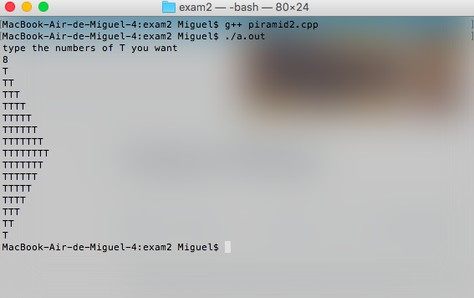
- Write a function called triangles which receives a single parameter (int) which represents the size of a triangle as explained below. The function should print a triangle using loops (for or while). The only characters printed here are ‘T’ and the new-line character. The first line is length one, the middle line is length size and the last line is length one.
The example below is for size 6:
Here’s my code:


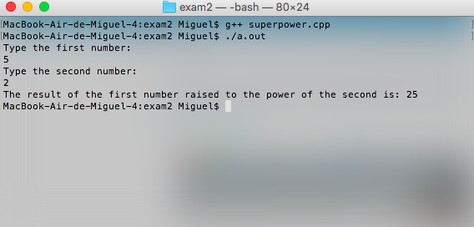
2. Write a function called superpower that has two parameters of type long and returns a long which is first parameter raised to the power of the second, which is to say it returns a b So, superpower(3,4) would return 81.
long superpower(long a, long b){
}
Here’s the code:


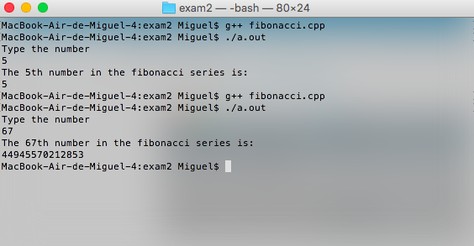
3. NOTE: for full 5 points, use a loop (not recursion). Write a function called fibonacci which receives a long “n” and returns a long which is the value of the nth number in the fibonacci series which is: 0,1,1,2,3,5,8,13,21,34,55,89………… So, fibonacci(0) would return 0. fibonacci(5) would return 5, fibonacci(8) would return 21. Note that the first two fibonacci numbers are 0 and 1. All others are the sum of the previous two fibonacci numbers.
Here’s my code:


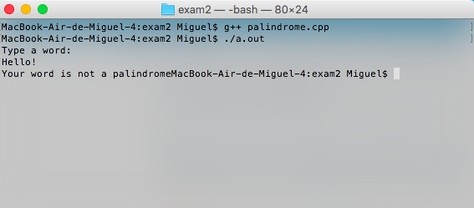
4. . Write a function called isPalindrome which receives a string “x” and returns true if the string x is a palindrome, otherwise false.
I had problems creating this one but yet at home I complete it and here is:


Hey guys, in this blog, well actually this tutorial I’m gonna explain just one of the ways that you can do the programs for our second partial exam with ken. The video is pretty long so I included in the video description the time at which I start explaining each program.
q1.cpp 0:38 q2.cpp 6:00 q3.cpp 10:00 q4.cpp 16:20
Here is the code for each one:
And of course here is the video tutorial, enjoy (I hope).
made by: Orlando Lara
#WSQ13 #TC101


1.- ejercicio solo es cuestión de saber la formula para encontrar distancias 8-)))..
2.- hacer una piramide de T’s .. por qué T’s?
3.- la serie de fibonacci .. 1, 1, 2, 3, 5, 8, 13, 21, 34, 55 <- posición 10.
4.- Elevar un número (a) a la potencia (b) con for.


