Create a “GitHub” account

--Originally published at TC101 – Peaz Cooper

Okay… Let’s start… this is very simple so there’s no need for a video tutorial.


GitHub is a web-based Git repository hosting service. It offers all of the distributed version control and source code management (SCM) functionality of Git as well as adding its own features. It provides access control and several collaboration features such as bug tracking, feature requests, task management, and wikis for every project.


1.- Go to the GitHub sign up page. This page is used to sign you up for a free GitHub plan.

2.- Enter a username, valid email address, and password.

3.- Review the GitHub Terms of Service and Privacy Policy before continuing.

4.- Click the “Create an account” button to complete the process.


Create a “WordPress” account

--Originally published at TC101 – Peaz Cooper

Okay… Let’s start… this is very simple so there’s no need for a video tutorial.


WordPress is a free and open-source content management system (CMS) based on PHP and MySQL. WordPress is installed on a web server, which either is part of an Internet hosting service or is a network host itself; the first case may be on a service like WordPress.com, for example, and the second case is a computer running the software package WordPress.org. An example of the second case is a local computer configured to act as its own web server hosting WordPress for single-user testing or learning purposes. (Wikipedia)


1.- Go to wordpress.com

2.- Sign up in register

3.- Create an account with your personal data

4.- Send me some food

5.- Rearrange the information

6.- Diversify your topics

7.- Create a lot of blog posts

8.- Throw shade at other student’s blog posts


Cadenas

--Originally published at Python Blog

Una cadena es una secuencia de caracteres. Ya las hemos usado para mostrar mensajes, pero sus usos son mucho más amplios que sólo ése: los textos que manipulamos mediante los editores de texto, los textos de Internet que analizan los buscadores, los mensajes enviados mediante correo electrónico, son todos ejemplos de cadenas de caracteres. ahora veremos unos ejemplos;

>>> "Un divertido "+"programa "+"de "+ "radio"
 
>>>'Un divertido programa de radio'
>>> 3 * "programas "
'programas programas programas '
 
>>> "programas " * 3
'programas programas programas '
>>> for x in "programas ":
...     print x
...
p
r
o
g
r
a
m
a
s
 
>>>


Create a “Twitter” account

--Originally published at TC101 – Peaz Cooper

Okay… Let’s start… this is very simple so there’s no need for a video tutorial.


What’s Twitter?

Twitter is an online news and social networking service where users post and read short 140-character messages called “tweets” (Wikipedia). This social network has improved the communication among the millennial age.


1.- Go to twitter.com

2.- Go to register

3.- Enter your personal info (don’t worry… the FBI has it anyway)

4.- Submit your request for an account

5.- Verify your account with your mail account

6.- Adjust your settings

7.- Follow @NotCooperfield (it is indeed necessary)

8.- Enjoy throwing shade to mortals


Diccionarios

--Originally published at Python Blog

Los diccionarios son usados para almacenar de un valor que necesitemos ver por ejemplo significados o valores.

materias = {}
materias["lunes"] = [6103, 7540]
materias["martes"] = [6201]
materias["miércoles"] = [6103, 7540]
materias["jueves"] = []
materias["viernes"] = [6201]

Course review

--Originally published at #TC101 – METANOIA

Well, this is it, today in a couple of hours I’ll go out there and do my final exam of the course. My opinions of it are mixed, however, I’d first of all like to thank Ken for his time, patience and most of all good attitude he has all the time. He is really a nice, understanding and accommodating person and I think that’s incredibly valuable for a teacher, a profession that may turn you into a cynical being in a short time.

Somehow the music transition went perfect, love my 360p camera.


Validating user input

--Originally published at Carolina's Blog Site

So when you ask the user for input, you need it to give you a valid input, something you can do whatever it is you wanted to do with it. For example, let’s say you ask for the user’s age because you wanna add something to it. Well, the user might write bdjsfkfs, you never know! So you must prepare accordingly.

First of all, be sure to specify when asking the user for input. Do not assume they know what you want from them. Have the program say things like “only integers, or rounded to the nearest whole number or in military time please.”

pink sweet minions despicable me agnes
source

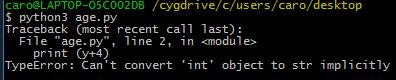
Now, when asking for input, it will always be given as a string, and you won’t be able to do math operations with it.

capture

One thing you must do is transform the user input into a number by using the int function. That way Python will automatically turn it into an integer and will be able to do math operations with it. Example:

age = int(input("Please enter your age: "))

Another great thing you can use in Python is the try/except statement, like this:

def valid_user_input(x):
    try:          #what you want it to do
        return int(x) > 2
    except ValueError:     #if an error happens,
        print ("please type an integer")     #do this
        return None


Bucle While

--Originally published at Python Blog

Un bucle while permite repetir la ejecución de un grupo de instrucciones mientras se cumpla una condición (es decir, mientras la condición tenga el valor True) .

Al iniciar el ciclo se evalúa la condición de la misma forma que si fuera un condicional..

sin-titulo2

sin-titulo22

La sintaxis del bucle while es la siguiente:

while condicion:
    cuerpo del bucle

Bucle For

--Originally published at Python Blog

Un bucle es una estructura de control que repite un bloque de instrucciones. Un bucle for es un bucle que repite el bloque de instrucciones un número prederminado de veces. El bloque de instrucciones que se repite se suele llamar cuerpo del bucle y cada repetición se suele llamar iteración.

sin-titulo1

sin-titulo11

La sintaxis de un bucle for es la siguiente:
for variable in elemento iterable (lista, cadena, range, etc.):
cuerpo del bucle

sin-titulo1 sin-titulo11 sin-titulo1 sin-titulo11